Python has become one of the most popular programming languages in the world. Whether you want to build websites, analyze data, develop AI models, or automate tasks, Python is often the first choice for beginners and professionals alike.
If you’re looking for free Python course notes and downloadable PDF e-books, this guide will help you understand where to find them, how to use them effectively, and how to learn Python step-by-step in 2026.
Why Learn Python in 2026?
Python continues to dominate the tech industry due to its simplicity and versatility.
Key Reasons to Learn Python:
- Easy to learn for beginners
- High demand in IT jobs
- Used in AI, Data Science, Web Development
- Strong community support
- Thousands of free resources available
Companies across industries rely on Python, making it a valuable skill for students and professionals.
What You’ll Get in Free Python Notes & E-Books
Most free Python resources include structured learning materials that cover:
Beginner Topics:
- Introduction to Python
- Installation and setup
- Variables and data types
- Input and output
Intermediate Topics:
- Functions
- Loops and conditionals
- Lists, tuples, dictionaries
- File handling
Advanced Topics:
- Object-Oriented Programming (OOP)
- Exception handling
- Modules and packages
- Working with APIs
Specialised Topics:
- Data Science basics
- Machine learning introduction
- Web development basics
- Automation scripts
Benefits of Using Python PDF Notes
Many learners prefer PDFs because they are simple and accessible.
Advantages:
- Offline access
- Easy to revise anytime
- Structured learning format
- Printable for study
- Quick reference guide
PDF notes are especially useful for students preparing for exams or interviews.
Who Should Use These Notes?
Python notes and e-books are suitable for:
- School and college students
- Engineering graduates
- Beginners in programming
- Job seekers in IT field
- Professionals switching careers
No prior coding experience is required to start learning Python.
How to Download Free Python Notes & PDFs
To access free Python learning materials:
Step 1:
Visit the provided website link.
Step 2:
Browse available Python notes and categories.
Step 3:
Select the topic or level (Beginner/Advanced).
Step 4:
Click on the download link for PDF.
Step 5:
Save the file for offline learning.
How to Learn Python Using These Notes
Downloading notes is not enough—you need a proper learning strategy.
Step-by-Step Learning Plan:
1. Start with Basics
Understand:
- Syntax
- Variables
- Data types
2. Practice Coding Daily
Use platforms like:
- Online compilers
- Practice websites
3. Focus on Logic Building
Solve simple problems like:
- Number operations
- Pattern programs
4. Move to Intermediate Topics
Learn:
- Functions
- Data structures
5. Build Projects
Examples:
- Calculator
- To-do list app
- Simple website
Best Free Platforms to Learn Python
Along with PDFs, you can use online platforms:
- Coursera
- edX
- Udemy
- Google (for beginner tutorials)
These platforms offer structured courses along with certifications.
Common Mistakes to Avoid While Learning Python
Many beginners struggle due to common mistakes.
Avoid These:
- Learning theory without practice
- Skipping basics
- Trying advanced topics too early
- Not building projects
- Lack of consistency
Python Career Opportunities
After learning Python, you can apply for roles like:
- Python Developer
- Data Analyst
- Machine Learning Engineer
- Web Developer
- Automation Engineer
Python skills can open doors to high-paying IT jobs.
Salary After Learning Python in India
Python professionals earn competitive salaries.
Average Salary Range:
- Freshers: ₹3–8 LPA
- Mid-level: ₹8–20 LPA
- Experienced: ₹20+ LPA
Salary depends on skills, projects, and experience.
Certifications That Can Boost Your Profile
After learning Python, consider certifications such as:
- Python Programming Certificate
- Data Science Certification
- Machine Learning Courses
- Cloud Certifications
These help improve your resume and job chances.
Tips to Master Python Faster
- Practice daily
- Write code regularly
- Work on real projects
- Learn from mistakes
- Join coding communities
Consistency is the key to mastering Python.
Why Free Resources Are Enough
You don’t always need paid courses to learn Python.
Free resources provide:
- Complete syllabus coverage
- Practical examples
- Real-world applications
With discipline and practice, free resources are enough to become job-ready.
Final Thoughts
Free Python course notes and PDF e-books are a great way to start your programming journey in 2026.
They provide structured learning, easy access, and a strong foundation for beginners.
However, success depends on how you use these resources. Focus on practice, build projects, and stay consistent.
If you follow the right approach, Python can help you build a successful career in IT, data science, or AI.
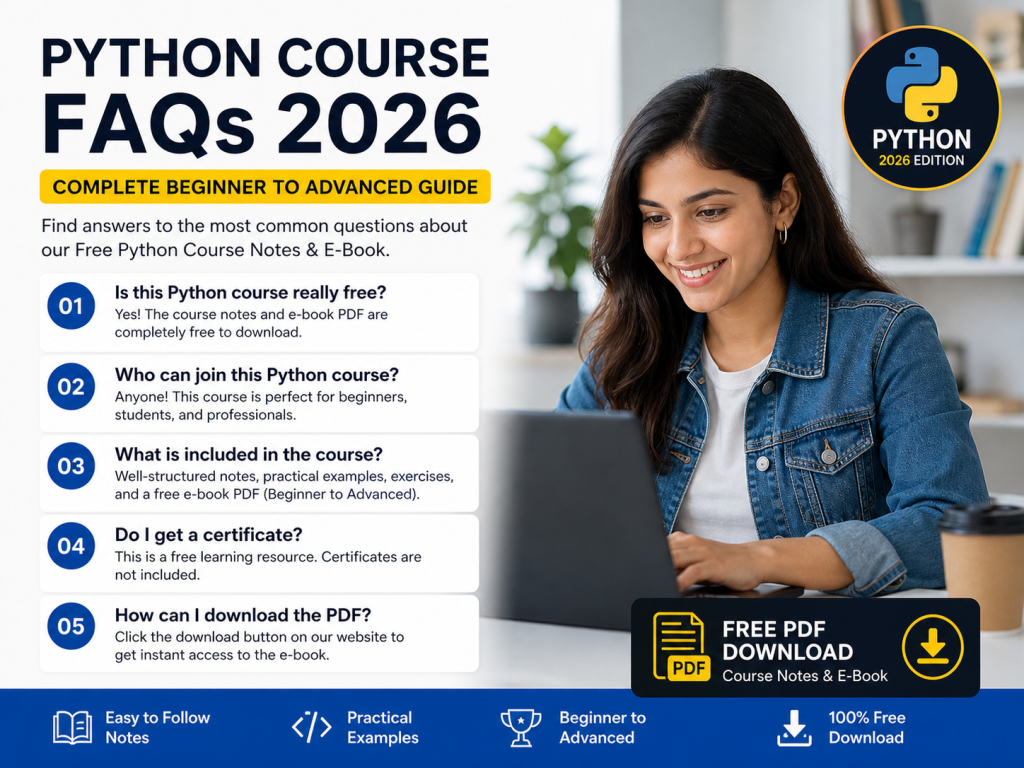
Python Course FAQs (2026)
1. Is Python easy to learn for beginners?
Yes, Python is one of the easiest programming languages due to its simple syntax and readability.
2. Do I need a coding background to learn Python?
No, you can start Python with zero programming experience.
3. How long does it take to learn Python?
Basics can be learned in 1–2 months, while mastering it may take 6–12 months depending on practice.
4. Is Python good for getting a job in 2026?
Yes, Python is in high demand for roles in data science, AI, web development, and automation.
5. Can I learn Python for free?
Yes, many platforms offer free courses, notes, and PDF resources.
6. Which is better: Python or Java?
Python is easier for beginners, while Java is more strict and used in enterprise applications.
7. What jobs can I get after learning Python?
You can become a Python Developer, Data Analyst, Machine Learning Engineer, or Web Developer.
8. Is Python enough to get a job?
Python alone is not enough—you also need projects, problem-solving skills, and basic tools like SQL.
9. Can non-IT students learn Python?
Yes, students from any background can learn Python easily.
10. Do I need a laptop to learn Python?
Yes, a basic laptop is recommended for practicing coding.
11. Which Python version should I learn?
Always learn the latest stable version, currently Python 3.x.
12. Is Python used in AI and Data Science?
Yes, Python is the most popular language for AI, machine learning, and data science.
13. How can I practice Python?
You can practice using coding platforms, building projects, and solving problems daily.
14. Are Python certificates useful?
Yes, they help improve your resume and increase job chances.
15. Can I learn Python on mobile?
You can learn basics on mobile, but a laptop is better for serious coding.
16. What are the best tools for Python beginners?
Popular tools include VS Code, PyCharm, and Jupyter Notebook.
17. How important are projects in Python?
Projects are very important—they show your practical skills to employers.
18. Can I earn money after learning Python?
Yes, you can work as a freelancer, developer, or get a full-time job.
19. Is Python better than C++?
Python is easier to learn, while C++ is more powerful for system-level programming.
20. What should I learn after Python basics?
After basics, learn data structures, frameworks (like Django), and tools like SQL.